Elementor LCP slow on mobile: what to check first
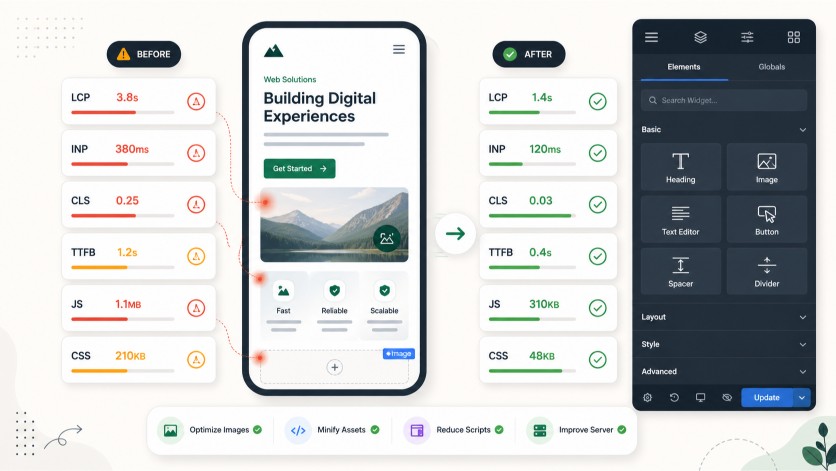
Elementor mobile LCP issues are often render-timing and main-thread problems, not just image size. The useful first step is proving whether the LCP delay sits in server response, hero rendering, CSS/JS, fonts, widgets, or third-party scripts.
When this usually happens
Common triggers
- after changing hero sections
- after adding animation or slider widgets
- after cache/minify changes
- after adding tracking scripts
- after template or theme updates
- after changing fonts or background images
Common causes
What could be misconfigured
- hero section rendered late
- Elementor CSS/JS blocking render
- animation/slider widgets delay LCP
- fonts load late
- background image not prioritized
- theme and Elementor templates both load heavy assets
- cache/minify conflict
Not always the plugin
When Elementor is probably not the root cause
Elementor may not be the root cause if the LCP delay is mostly server response, CDN behavior, third-party scripts loaded outside Elementor, or a theme template that wraps the Elementor content.
What I check first
The first checks stay close to the symptom
First sprint scope
What the first sprint includes
- map the LCP path on representative Elementor URLs
- fix safe image, font, cache, CSS, or script loading issues where access allows
- separate Elementor-specific work from hosting or theme constraints
- verify the selected URL again after changes
Verification
How the fix is checked
What I need from you
Useful intake details
- representative Elementor URL
- mobile PageSpeed result if available
- what changed recently
- WordPress admin access
- cache/CDN/hosting access if implementation is needed
What is not included
Scope boundary
- complete Elementor redesign
- theme rebuild
- all-page optimization
- generic performance report
- ranking guarantee
Price anchor
Small diagnostics usually start around $350. Focused WordPress technical sprints usually land between $650 and $1,500+.
See pricing bandsRelated WordPress problems
First sprint intake
Send the URL, the exact symptom, and what changed recently.
A useful first message includes the WordPress URL, affected pages, recent changes, plugin stack, and which tools you can grant access to.